Ho Chi Minh City is Vietnam’s largest city and economic hub, with a population of over 9 million. Formerly known as Saigon, it served as the capital of South Vietnam (officially the Republic of Vietnam) from 1954 until 1975. The city was officially renamed in 1976 following the reunification of Vietnam, in honour of revolutionary leader Ho Chi Minh.
Day 9 – Fly to Vietnam + Independence Palace
We boarded another early flight and arrived in Ho Chi Minh City. As we made our way into the city, one of the first things I noticed was the abundance of propaganda signs and posters. Many of them feature a Socialist Realism art style, reminiscent of Soviet and Chinese communist propaganda.

These posters are often used to celebrate national holidays, promote socialist ideals, and encourage patriotism and community pride. Seeing them throughout the city was a constant reminder that Vietnam is a socialist country, and of its revolutionary past and long struggle for independence from colonial rule.

One of our first stops was the Independence Palace, the former presidential residence of South Vietnam. It was here that the Fall of Saigon took place on April 30, 1975, marking the end of the Vietnam War, when a North Vietnamese tank crashed through its gates.


Day 10 – Cu Chi Tunnels and City Exploration
We started the day at the Cu Chi tunnels, an extensive underground network used by the Viet Cong to move undetected. These tunnels served as communication and supply routes, as well as housing food and weapon caches, hospitals, and living quarters.

The tunnel system played a crucial role in the Viet Cong’s resistance against American and ARVN forces, helping them counter a much stronger military presence.

After reunification, the Vietnamese government preserved the Củ Chi tunnels as a national monument, war memorial, and educational site. Today, it’s a popular tourist destination, where visitors can crawl through sections of the tunnels that have been widened for accessibility.


You can travel through over 100 metres of tunnel, with sections becoming narrower every 20 metres and exit points along the way. I personally only made it through the first 20 metres, as I found it was already incredibly tight. I can’t imagine what it would have been like navigating the original tunnels.

At the site, you can also see various types of booby traps used by the Viet Cong. These were designed to injure, disable, and demoralize American and South Vietnamese forces rather than kill instantly. They were typically low-cost and made from materials like bamboo, wood, and repurposed unexploded ordnance. Despite their simplicity, they were highly effective, contributing to a significant portion of wartime casualties.


On our way back to the city, we stopped at Handicapped Handicrafts, a lacquerware workshop and shop that employs artisans with disabilities, including victims of Agent Orange. Here, artisans create intricate, high-quality pieces, such as paintings, vases, and boxes, using materials like eggshells, mother-of-pearl, and wood


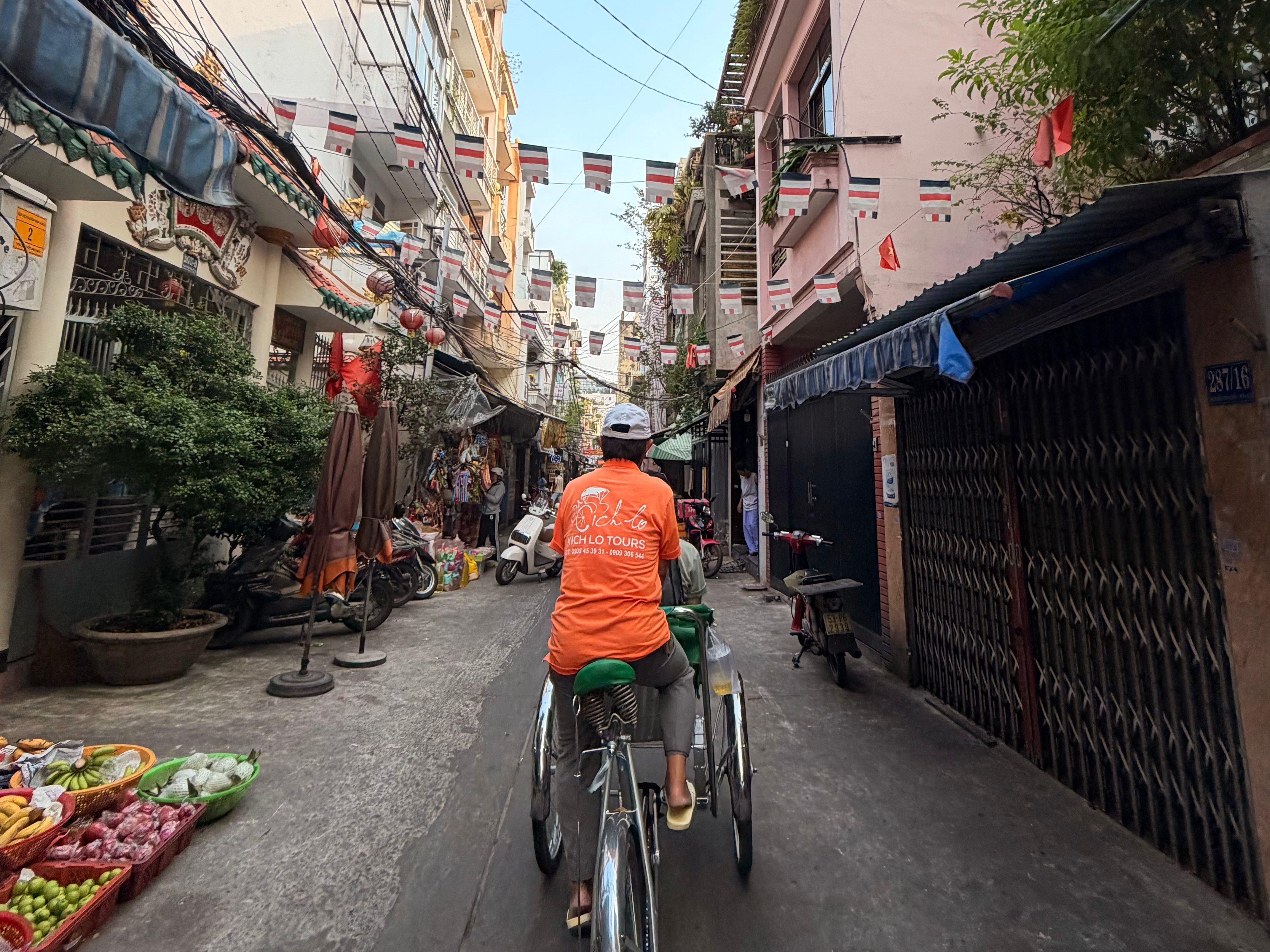
In the afternoon, our tour director organized a rickshaw tour. One of our stops was the Secret Weapon Bunker.


This bunker was built by Trần Văn Lai, an interior designer and contractor who secretly worked with the Viet Cong’s Saigon commando unit. In 1966, he purchased a house at 287/70 Nguyễn Đình Chiểu Street in District 3. Over several months, he constructed a hidden cellar beneath the home. To avoid suspicion, he removed the excavated soil in small amounts, transporting it away in his car at night.

The bunker was used to store weapons smuggled into the city in bamboo baskets and hidden within everyday goods. These weapons were later used during the 1968 Tet Offensive, including attacks on key government sites like the Presidential Palace. Today, the site has been preserved as a small museum, where nearly three tons of wartime weapons remain.

Our next stop was the Venerable Thích Quảng Đức Monument. On June 11, 1963, Thích Quảng Đức, a Buddhist monk, carried out a self-immolation at a busy intersection in Saigon in protest of the persecution of Buddhists by the South Vietnamese government.

He calmly sat in the lotus position while another monk poured gasoline over him. Holding a string of prayer beads, he recited “Nam mô A Di Đà Phật” (“Homage to Amitābha Buddha”), then struck a match and set himself alight.

We then went to Paris Commune Square, where we saw several historic landmarks, including the Saigon Central Post Office and the Notre-Dame Cathedral Basilica of Saigon.
The Notre-Dame Cathedral Basilica of Saigon was built by the French between 1877 and 1883 and is known for its neo-Romanesque red-brick exterior and towering spires. Unfortunately, it is currently covered in scaffolding as it undergoes a major restoration expected to last until at least 2027.

Saigon Central Post Office, built between 1886 and 1891 during the French colonial era, has long served as a central communication hub. It is renowned for its grand, vaulted, train-station-style interior and remains a fully operational historic post office in the city centre.


From Paris Commune Square, we could see the roof of the Pittman Building, a former CIA safe house that appears in an iconic photograph by Dutch photographer Hubert van Es. The image, showing an Air America helicopter evacuating people during the Fall of Saigon, has become a lasting symbol of the end of the Vietnam War.

We ended our rickshaw tour at the Ho Chi Minh City People’s Committee Building, Saigon’s former colonial city hall, which now stands behind a statue of Ho Chi Minh, symbolizing Vietnam’s journey from colonial rule to independence.


Leave a Reply