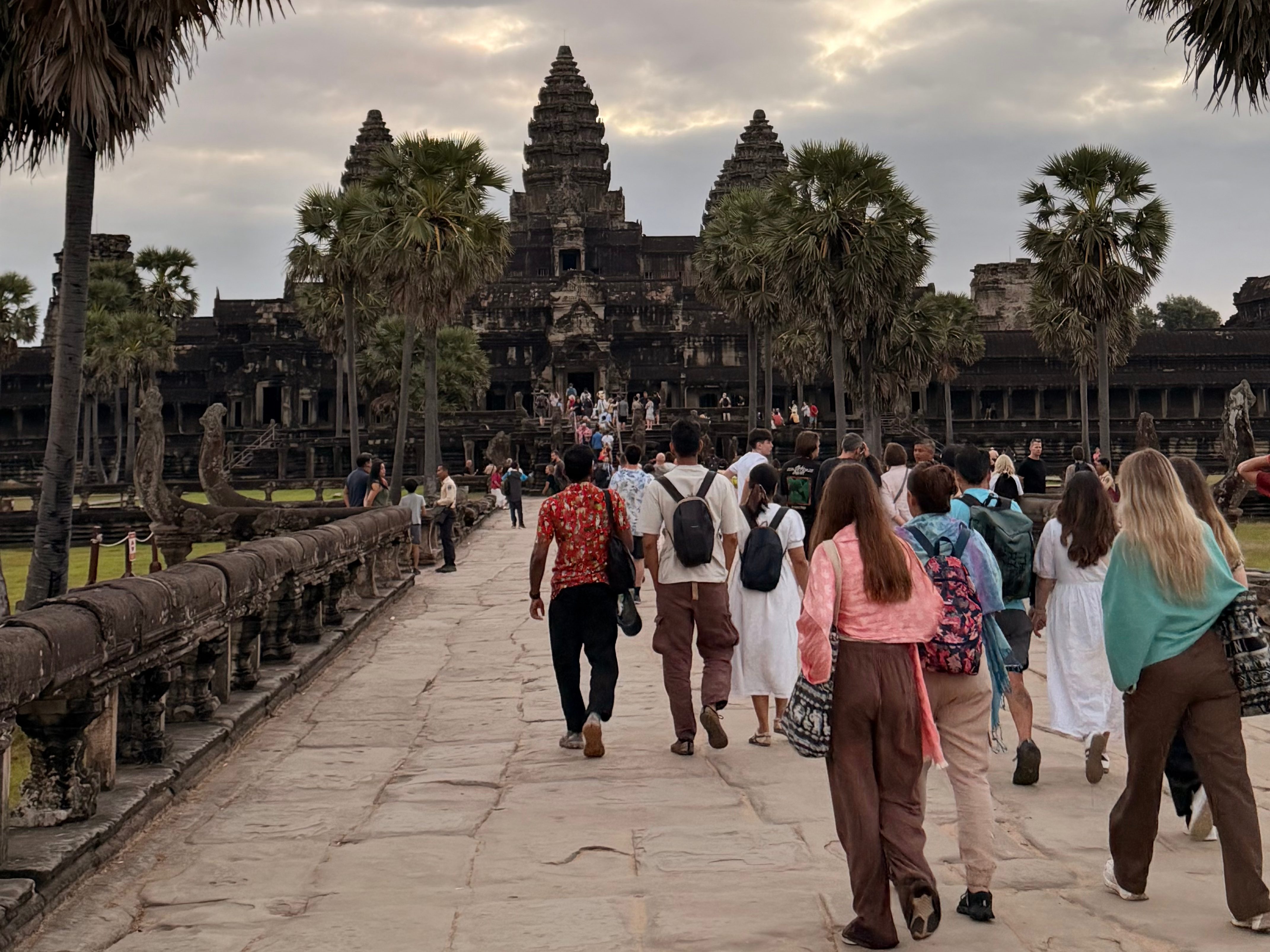
Our second leg of the tour is Siem Reap, the second-largest city in Cambodia and serves as the gateway to Angkor Wat.
Cambodia is a beautiful country, but it has endured immense hardship over the past decades. To truly understand Cambodia, its people, and its social context, it’s important to acknowledge this history.
Cambodia’s Tragic Past
During the Vietnam War, Cambodia experienced extensive U.S. bombing campaigns between 1969 and 1973, which killed thousands of civilians and devastated rural communities. In 1970, a U.S.-backed military coup overthrew the government, leading to a five-year civil war.
Out of this instability, the Khmer Rouge, led by Pol Pot, rose to power in 1975. They implemented a radical agrarian ideology, forcing people into labour camps and attempting to reshape society. This led to a four-year genocide.
Between 1975 and 1979, an estimated 1.5 to 2 million people, nearly a quarter of Cambodia’s population, died from forced labour, starvation, torture, and mass executions under the Khmer Rouge regime.
In January 1979, Vietnamese forces overthrew the Khmer Rouge, effectively ending the genocide. This was followed by a decade-long Vietnamese military occupation in Cambodia, which lasted until September 1989. The conflict formally moved toward resolution with the 1991 Paris Peace Agreements, which paved the way for a United Nations peacekeeping mission and the eventual restoration of stability in Cambodia.
Day 6 – Travel to Cambodia
Our itinerary originally had us taking a bus to Cambodia, but the land border was closed due to disputes between Thailand and Cambodia. Instead, we boarded an early morning flight to Siem Reap, arriving much earlier than expected. What was supposed to be a full day of travel turned into extra free time, which was a great bonus.
Artisans Angkor
Since we arrived early, our tour director organized a visit to Artisans Angkor, a social enterprise dedicated to reviving traditional Khmer craftsmanship, such as stone carving and silk weaving, while providing employment for rural artisans. They also contribute to the restoration of Angkor’s historic sites by repairing and recreating damaged sculptures.


APOPO Visitor Center
Our tour director also suggested visiting the APOPO Visitor Center, where rats are trained to detect landmines. Cambodia remains one of the most heavily landmine-affected countries in the world, with an estimated 4–6 million landmines and unexploded ordnance remaining after decades of conflict.

At first, I was a bit hesitant when I heard “rats,” but these African giant pouched rats are much larger, and cuter than I expected. These highly trained animals use their strong sense of smell to detect explosives, significantly speeding up the process of clearing mines. Known as “HeroRATS,” their work saves lives and helps return land to communities for farming and development. As of April 2025, they have helped clear over 169,000 landmines and explosive remnants of war worldwide.


The trainers even let you hold one for a photo, definitely one of the highlights of the trip for me.

Phare The Cambodian Circus
Another activity suggested by our tour director was Phare The Cambodian Circus. This troupe combines theatre, music, dance, and modern circus arts to tell uniquely Cambodian stories. While circus arts have been part of Cambodian culture for centuries, they were nearly lost during the Khmer Rouge regime, when all forms of art were banned, and artists were persecuted; an estimated 90% were killed.

Founded by nine young refugees and their art teacher, Phare Ponleu Selpak is a non-profit public school and arts school in Battambang. It was created to help underprivileged and traumatized children process war experiences, revive Khmer culture, and escape poverty through arts education, including circus, visual arts, and music.


Today, the organization supports around 1,200 students in its public school and 500 in its arts schools. Phare The Cambodian Circus provides students and graduates with a space to hone their skills and earn a sustainable income. The circus performs nightly under a big top, and 75% of its profits go toward supporting Phare Ponleu Selpak.


I didn’t know what to expect, but the performance was incredible. Watching it, I realized this wasn’t just a show, but a reflection of Cambodia’s strength and its determination to rebuild and preserve its culture.
Day 7 – Sunrise at Angkor Wat
Some places in the world feel almost unreal, and Angkor is one of them. Watching the sunrise over ancient temples that have stood for centuries was something I had been looking forward to, and it ended up being one of the most memorable experiences of the trip.
We had an early morning, leaving our hotel at 5 AM to make our way to Angkor. Located just outside Siem Reap, the Angkor Archaeological Park is a breathtaking temple complex and UNESCO World Heritage Site. Once the heart of the powerful Khmer Empire, it features dozens of major temples and hundreds of smaller shrines and ruins, built between the 9th and 15th centuries. Spanning over 400 square kilometres, Angkor is the largest religious site in the world.
Angkor Wat
We arrived in the dark, using our phone flashlights to guide us along the path to Angkor Wat, the largest and most well-known temple in Angkor. The temple covers an area of 162 hectares (400 acres), making it the largest religious monument in the world. This 12th-century complex was originally built during the reign of the Khmer king Suryavarman II as a Hindu temple dedicated to Vishnu, and later transitioned into a Buddhist temple.

We reached the reflecting pond just before sunrise and joined the crowds waiting to capture the temple’s iconic reflection. It was busy, but that’s expected at such a world-famous site. Afterward, we had about an hour to explore the temple grounds.


Ta Prohm
Next, we visited Ta Prohm, built in the late 12th and early 13th centuries under King Jayavarman VII. Originally a Buddhist monastery and centre of learning dedicated to his mother.

Unlike many other temples in Angkor, Ta Prohm has been left largely in its natural state. Built without mortar, the structures were gradually overtaken by massive tree roots after the site was abandoned, creating the striking impression of the temple being swallowed by the jungle, one of the reasons it’s so popular with visitors.


Bayon Temple
Our final stop was Bayon, a Buddhist temple built in the late 12th or early 13th century as the state temple of King Jayavarman VII.

Often referred to as the “face temple,” Bayon is famous for its towering stone faces. Its 54 towers are adorned with 216 large, serene faces believed to represent Avalokiteshvara (or possibly the king himself).

The temple also features approximately 1.2 kilometres of intricate bas-reliefs, depicting over 11,000 figures and scenes from daily life and historical events.

Even with the crowds and the early wake-up, it was absolutely worth it. From the grandeur of Angkor Wat to the jungle-covered ruins of Ta Prohm and the quiet mystery of Bayon, each site offered something unique.
Day 8 – The Countryside and Tonle Sap Lake
On our final day in Cambodia, we joined an optional countryside tour organized by our tour director.
Our first stop was Wat Preah Prom Rath, a Buddhist monastery in the heart of Siem Reap. Our tour director shared that he lived there during university in exchange for helping maintain the grounds, something common for students from rural communities who cannot afford housing. While there, we received a blessing from the monks.


Next, we visited Preah Dak Market, where we learned how to make num akor, a traditional Cambodian steamed rice cake made from fermented rice flour and palm sugar, filled with a creamy coconut centre. It was fluffy, slightly chewy, and easily my favourite dessert of the trip.


We then stopped at a family-run roadside noodle shop, where fresh rice noodles are made daily. These small eateries are popular among locals, offering quick, affordable, and delicious meals.


Our final countryside stop was a nearby village, where we rode in a water buffalo cart. Water buffalo are essential to Cambodian agriculture, often referred to as “living tractors” for their role in plowing rice fields and transporting goods. As we rode through the village, children waved as we passed.


Later that afternoon, we took a relaxing cruise on Tonle Sap Lake, a UNESCO Biosphere Reserve and the largest freshwater lake in Southeast Asia. Known for its floating fishing villages, it is one of the most productive inland fisheries in the world, providing over 60% of Cambodia’s protein intake.


I wasn’t expecting much from Cambodia, just a stopover between Thailand and Vietnam to visit Angkor Wat. But it quickly became the highlight of my trip, leaving me wanting more and already hoping to return.

Leave a Reply