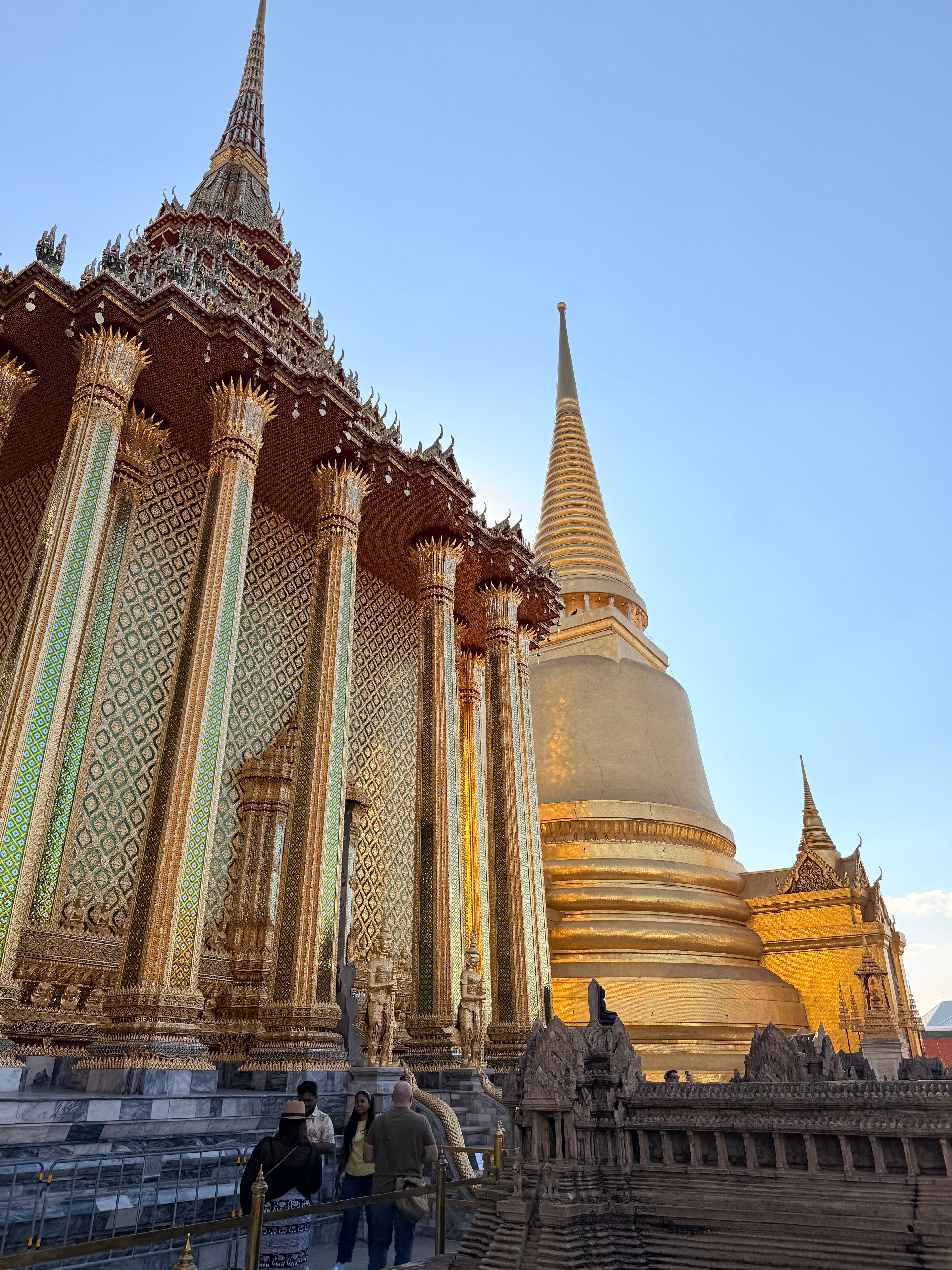
Bangkok, the capital and largest city of Thailand, is home to nearly a quarter of the country’s population. This bustling metropolis is known for its vibrant markets, incredible street food, and its ornate temples rising among skyscrapers.
Day 1 + 2 – Flying to Bangkok
I flew from Seoul and arrived in Bangkok late in the evening, heading straight to the hotel to check in and settle for the night. I stayed at ASAI Bangkok Chinatown, where the room was clean, comfortable, and exactly what I needed after a long day of travel. The location was especially convenient, as it was connected to a mall with multiple vegan options and a 7-Eleven, perfect for a quick bite or a late-night snack.

Day 3 – Touring Bangkok
In the morning, I met the group in the lobby to catch our bus. This is where the tour truly began. We made our way to Khlong Lat Mayom Floating Market, where we hopped on a traditional long-tail boat. We cruised along the canals, spotting Asian water monitors and stopping at a local orchid farm. It was a relaxing and memorable start that set the tone for the rest of the trip.


Wat Arun
Our next stop was Wat Arun, or the Temple of the Dawn, a Buddhist temple located on the west bank of the Chao Phraya River. The temple is named after the Hindu god Aruna. Although it dates back to at least the 17th century, its iconic central prang (spire) was constructed in the early 19th century during the reigns of Rama II and Rama III.


What stood out most to me was its unique Chinese-influenced aesthetic. The 82-metre central spire is decorated with over one million pieces of multicoloured glazed Chinese porcelain and seashells, making it one of the most visually striking temples in Thailand.


Grand Palace & Wat Phra Kaew
We then took a short ferry ride across the Chao Phraya River to the Grand Palace, which served as the official residence of the Kings of Siam (and later Thailand) from 1782. Although it has not been the monarch’s primary residence since 1925, it is still used for royal ceremonies and state functions.


Within the palace grounds is Wat Phra Kaew, Thailand’s most sacred and important temple. It was commissioned by King Rama I in 1782 as his personal chapel and as the home of the revered Emerald Buddha. Each successive king has contributed to the complex, adding to its design and donating precious objects as a way of reaffirming their devotion to the sacred.


Wat Phra Kaew is home to the Emerald Buddha, a highly revered statue carved from a single piece of green jasper. It is considered the most sacred religious artifact in Thailand and is believed to bring prosperity and good fortune to the land in which it resides. According to legend, the statue originated in India, moved to Sri Lanka, then Cambodia, before finally arriving in Thailand.

Day 4 – Markets and an Organic Farm
We started early at the Maeklong Railway Market, a unique market set directly on active train tracks. As the train approaches, vendors quickly retract their awnings and move their goods—only to resume business moments after it passes.

Next, we visited Damnoen Saduak Floating Market, one of Thailand’s most famous markets. Personally, I didn’t enjoy this one as much as the previous day’s boat tour—it felt much busier and more touristy. Our tour director recommended avoiding souvenirs here since they’re often cheaper elsewhere, and advised negotiating prices, as items are typically marked up. He also suggested buying snacks from the older women vendors, as they tend to have fairer prices and are simply trying to earn a bit of extra income.


We then visited an organic farm, where we learned about sustainable rice farming. Some members of our group went into the rice paddies to transplant seedlings (I personally skipped that part).


We also learned the traditional process of preparing rice: using a large wooden mortar and pestle to loosen the hulls, a milling stone to remove them, and a winnowing basket to separate the rice from the chaff.

Afterward, we participated in a potpourri-making workshop using dried flowers grown on the farm, mixed with essential oils.


Later that evening, a few of us went out on our own to watch Muay Thai, or Thai boxing. This 13th-century martial art is known as the “Art of Eight Limbs”; it uses punches, kicks, knees, and elbows in full-contact combat. It was an incredible experience, blending intense sport with deep cultural, musical, and spiritual traditions.


Day 5 – Exploring Talat Noi and Shopping
On our final day in Bangkok, we began with a walking tour of Talat Noi, a historic neighbourhood along the Chao Phraya River near Chinatown. It’s known for its strong community feel, street art, trendy cafés, and old auto repair workshops.

Our first stop was a 22-foot-tall Optimus Prime statue made entirely from recycled car parts. It became popular after a nearby bar owner’s wish for business success came true following an offering of engine oil, leading to a traditional Thai gae-bon (vow redemption) ceremony.

We then visited the Talat Noi Museum to learn about the area’s historic Chinese communities, followed by Horseshoe Shrine, a 200-year-old Hakka shrine.


The neighbourhood is also famous for its street art, particularly along Trok San Chao Rong Kueak, an alleyway filled with vibrant murals.


Our final stop brought things full circle with another Transformer, Bumblebee.

After the tour, we took a taxi to ICONSIAM, a massive luxury mall, where we did some last-minute shopping before heading to Cambodia the next morning. Of course, I had to visit the world’s largest POP MART store and pick up some Thailand exclusives.


Leave a Reply